AI Next Labs / Blog
The Coyote That Never Fell
In 2016, the godfather of AI told the world to stop training radiologists. A decade later the opposite had happened, and the shape of his mistake is the most useful map we have for what to become in the age of AI.
Published

Right now, somewhere, someone brilliant and very sure of themselves is explaining why your job is about to disappear. It happens every few months. The faces change, the numbers change, but the deadline is always about five years away. So before you believe the next confident voice, it is worth looking at what happened the last time a genius stood up and told an entire profession it was already finished.
In 2016, the genius was Geoffrey Hinton, the man often called the godfather of AI and, years later, a Nobel laureate. He told a conference it was “completely obvious” that within five years machines would read medical scans better than any doctor, so the world should simply “stop training radiologists.” To make sure no one missed the point, he compared a radiologist to a cartoon coyote that has already sprinted off the edge of a cliff but has not yet looked down.
The prophecy spread fast. For years the message to anyone considering radiology was that the field was a dead end, and plenty of bright students listened and chose something else, stepping off the cliff before it could crumble under them.
There was just one problem. A decade later, the coyote still has not fallen. Radiology did not shrink; it boomed. Radiologists are now in such short supply that scans sit backlogged for months, their salaries have climbed, and at the Mayo Clinic, the very institution Hinton’s prophecy should have gutted first, the radiology department has grown by roughly 55% since his speech, to more than four hundred specialists.
Hinton was not wrong about the technology. He was wrong about something deeper, and his mistake is the most useful map I know for anyone deciding what to become in the age of AI. So before you pick which cliff you are standing on, it is worth understanding exactly what he missed.
What the prophet got wrong
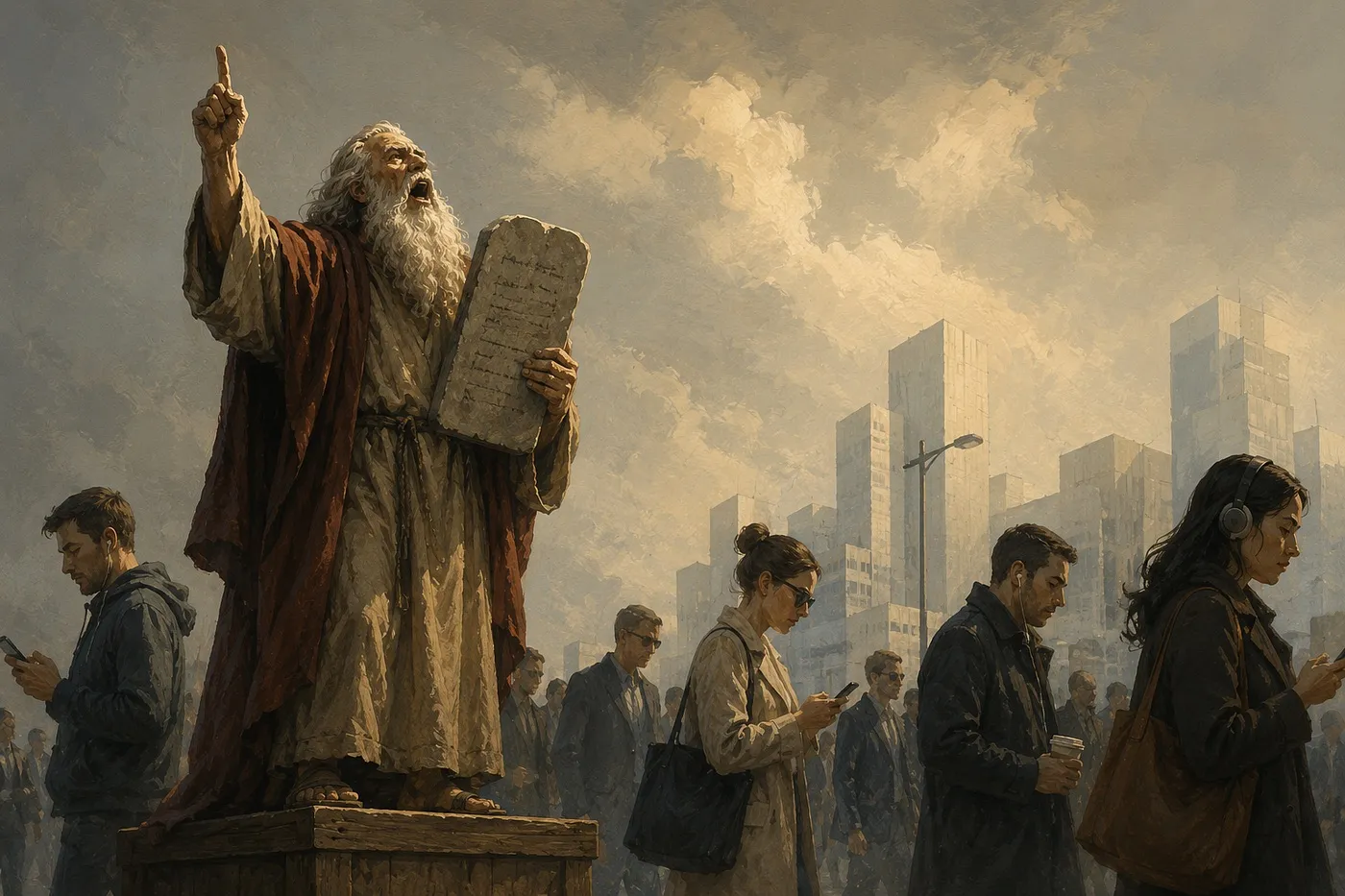
Hinton confused a task with a job.
A radiologist’s job was never “look at the image.” That’s a task. The job is to diagnose the patient: to weigh the scan against the history, the bloodwork, the conversation with the worried clinician down the hall, the gut sense that something doesn’t add up. Studying the image is just one task performed in service of the real job. AI is breathtakingly good at swallowing tasks. It cannot own a job, because owning a job means owning the judgment and the consequences, and a model owns neither.
That neat “task versus job” framing, I should admit, comes from Jensen Huang, CEO of Nvidia, the company that has made more from the AI boom than any other on earth. Take his optimism with a fistful of salt; he is, after all, selling the shovels. Critics also note that radiology’s growth owes more to a chronic shortage and rising scan volumes than to AI. They may be right about the cause. But the observation survives the quibble, because the numbers back it, not the billionaire: the profession declared dead did not collapse. It grew, and it absorbed the machine.
Watch how it absorbed the machine and you can see the real shape of the future. Mayo didn’t fire its radiologists and install an algorithm. It did something stranger. It hired a second kind of person.
Today Mayo runs more than 250 AI models across its health system. Keeping those models useful, auditing them, tuning them, wiring them into the daily rhythm of clinical work, falls to a dedicated team of roughly forty AI scientists, engineers, and researchers who sit beside the radiologists. Forty builders. Four hundred specialists. Not rivals. Multipliers.
That second kind of person is new, and the economy is minting them by the thousand. Call them implementers: the people who take a general-purpose intelligence and make it actually work inside a specific, messy, real-world domain. A retrieval system for a law firm. A diagnostic aide for a clinic. A forecasting tool for a logistics company. Implementers aren’t building AI from scratch. They’re building the plumbing that connects it to the people doing the work.
Picture one of them on a Monday. She has been hired by a mid-sized insurer that wants a large language model to handle the first pass on claims, and she has never worked in insurance in her life. So her first two weeks involve almost no code at all. They are spent sitting beside adjusters, watching how a claim actually moves through the building, learning which decisions are routine and which carry real liability, finding out where the regulations bite and where a wrong answer means a lawsuit rather than a typo. Only once she understands the work does she start to build.
And what she builds is rarely the glamorous part. It is the retrieval layer that pulls the right policy clauses, the evaluation harness that catches the model the moment it confidently misreads a coverage limit, the unglamorous decision to route anything ambiguous back to a human adjuster instead of letting the model guess. The single most valuable thing she does is know where the model must not be trusted, and that knowledge comes entirely from having learned the domain well enough to smell the danger. A year later she packs up and does it again for a logistics firm, then a hospital, then a bank. The industry changes every time. The craft does not.
That is the implementer: not the person who knows the most about insurance, and not the person who knows the most about machine learning, but the person who can learn a new domain fast enough to wire intelligence into it without breaking it. The specialist owns the judgment at the edge. The implementer builds the system that lets that judgment scale.
And here is the first thing the prophecy missed: AI didn’t kill the specialist. It created a partner for the specialist, and quietly opened up an entirely new way to be valuable.
Which brings us to you.
Two roads out of the same classroom
Picture two people graduating this year, both staring at the same headlines you are.
The first, call her the Specialist, goes deep into a single field. Medicine, law, mechanical engineering, financial analysis. She’ll spend a decade accumulating the dense, tacit, hard-won judgment of her domain, and somewhere along the way she’ll pick up enough AI fluency to use the tools in her work.
The second, call him the Implementer, goes deep into the craft of implementation itself. He never settles in one industry. The nature of his work drags him across all of them: a healthcare project this year, supply-chain logistics the next, then legal tech, then manufacturing. Every engagement forces him to parachute into an unfamiliar world and learn it fast enough to build something that works.
On graduation day, there’s no contest. The Specialist is far more valuable. Her domain intuition is scarce and precious; his AI skills are shallow, generic, and changing every few months. If you hired one of them in year one to lead a project in a hospital, you’d want the doctor who learned to code, not the coder who’d never set foot in a hospital.
Now run the clock forward ten years, and something surprising happens.
Because the Implementer was forced by his work to keep entering new worlds, his “ability to learn” stopped being a soft trait and quietly compounded into a hard asset. He has built a vast, transferable library of patterns: how people resist a new tool, where data pipelines always rot, how to build an evaluation framework that actually catches failures, how to earn an institution’s trust. He has become a deep specialist after all, a specialist in arriving.
There’s an old contrast that captures this. When a war breaks out, you depend at first entirely on the local fixer who knows every street and every alliance. But the veteran correspondent who has covered twelve conflicts arrives carrying a different and equally rare depth: the ability to read a new war faster than the locals, to see the structural patterns they’re too close to notice. Spend ten years arriving, and arriving becomes a form of mastery.
Don’t over-read this, though. By year ten the Implementer still cannot sign off on a diagnosis or stamp a structural drawing; the Specialist’s sovereign judgment is untouchable. The flip happens in a narrower arena, architecture and leadership: the person who can walk into any domain and design the system that fits it tends to become the natural architect of the enterprise, while the person who only ever knew one room finds the bigger rooms closed to them.
And how fast the flip arrives depends on one variable: how much irreducible, tacit judgment a field demands. In neurosurgery or constitutional law, deep domain knowledge stays scarce for decades, and the Specialist holds her edge for a very long time. In growth marketing, sales operations, or general enterprise software, the Implementer’s portable methodology takes over almost at once.
So which road should you take? Here’s the trap: the question contains a hidden assumption that will wreck you no matter which road you pick.
The trap disguised as a shortcut

Both roads demand the same thing: the ability to learn, deeply and fast. And we are living through the worst possible moment to count on it.
For two decades, Dr. Gloria Mark has been measuring how long people actually hold their focus on a single screen before something pulls them away. In 2004 the average was about two and a half minutes. By 2012 it had fallen to seventy-five seconds. In her recent multi-year tracking, it sits at roughly forty-seven seconds. We are trying to master complex, layered domains in forty-seven-second bursts, and AI, the very tool that’s supposed to make us more capable, is also the most frictionless shortcut to never thinking deeply at all.
The cost of that shortcut now has a name. Researchers at BetterUp Labs and Stanford’s Social Media Lab call it workslop: AI-generated output that looks polished and finished but carries no real substance, the corporate equivalent of frosting with no cake underneath. Their findings are bleak. Around 40% of workers say they regularly receive workslop from colleagues. Each instance costs the recipient roughly two hours of cleanup. And nearly one in five workers admit to knowingly sending work they understood was low quality, quietly shoving their own thinking onto whoever sits downstream.
This is the secret behind one of the strangest facts in business right now. In controlled studies, AI delivers enormous gains. A Stanford writing experiment found a 40% drop in time taken; a study of 5,000 customer-support agents found a 14% jump in productivity. Yet a 2025 MIT study tracking an estimated $30 to $40 billion of corporate AI investment found that roughly 95% of organizations saw no measurable return at all. (That 95% figure has been picked apart by some critics, and it deserves the scrutiny, but even halved it would still be damning.)
How can both be true? Because the gain only materializes when a skilled human brings judgment to the machine’s output, and that is rarer than the demos suggest. The largest review ever done, a meta-analysis of 106 studies, found human-and-AI teams on average performed worse than the better of the two alone. The pattern was telling: when the human outclassed the AI, the pairing soared; when the human was weaker and merely rubber-stamped it, the pairing sank. Pair the machine with deep judgment and you reach the ceiling; pair it with shallow skimming and you crash through the floor. An implementer who never truly learns the domain doesn’t solve problems, he builds an efficient workslop engine, a confident, fluent, subtly-wrong system that generates endless cleanup downstream. He is the bad translator who speaks beautifully and means the wrong thing.
That’s the trap. The market is paying more than ever for deep learning, the human kind, at the exact moment our tools are training us to skim. Win the shallow game and you become a dash: a résumé that’s a mile wide and an inch deep, instantly replaceable.
But before we get to what does work, look up from your desk for a moment, because that same gap, between what AI can do and what it actually delivers, is playing out on a far bigger stage, with a great deal more money riding on it.
The same mistake, with three more zeros
Step back and look at the stock market, because the same gap, capability sprinting ahead of returns, is unfolding there too with about three more zeros attached. The companies building AI are pouring hundreds of billions of dollars a year into it, on the bet that the revenue will soon arrive across the whole economy. And the most rigorous look at that bet, the MIT study from a moment ago, found that so far, for 95% of companies, it hasn’t. The market is valuing AI as though it already owns the jobs. The ground truth is that it mostly still does the tasks. That is Hinton’s mistake one more time, capability mistaken for displacement, only now it’s priced into the S&P 500.
I won’t pretend to know how that resolves. Market prices are messy, spending can stay irrational for years, and this is genuinely not the year 2000 wearing a new hat: most of the money is real earnings rather than debt, and much of the infrastructure will be useful whatever happens. I’m not predicting a crash, and no one can honestly time one. The narrow, defensible point is the only one that matters here: the prices assume a future the evidence on the ground has not yet delivered. Whether it closes on schedule is something you’ll have to judge for yourself, especially since the people promising it will are the ones we’re about to meet.
The prophets are talking their book
Now look at the people narrating all this, because they are anything but neutral. Here is the rule I’d press on you above everything else in this essay: never take a CEO’s description of the future at face value, because every one of them has a valuation to defend, and the story that pumps the valuation is rarely the story that’s true. Sam Altman, whose OpenAI is valued around half a trillion dollars despite not turning a profit, writes that “the takeoff has started” toward digital superintelligence. Dario Amodei, whose Anthropic is valued near $380 billion, forecasts a “compressed 21st century” and the disappearance of half of all entry-level white-collar jobs within five years. Vast, unfalsifiable claims, from the two men with the most on earth to gain from your believing them.
You don’t have to take my word that the incentive is talking; just watch it collide with itself. In the summer of 2025, Altman called the market a bubble that would cost someone a fortune. Then, in the same breath, he announced OpenAI would spend trillions building datacenters, all while raising his company’s valuation from $300 billion to $500 billion in a matter of months. Warn of a bubble with one hand; raise at a record price with the other.
Or take the purest example. In early 2026, Jensen Huang said he would be “deeply alarmed” if one of his $500,000 engineers spent only $5,000 a year on AI tokens; the right figure, he suggested, was closer to $250,000, fully half their salary, and he floated handing engineers token budgets that size as a recruiting perk. The man whose company sells the chips that process those tokens is telling every business on earth that its engineers should burn far more of them. You do not need to guess who profits. It is not a description of how to work well. It is an advertisement for his product, wearing the costume of a productivity standard.
And the prophets can’t even agree with each other: Amodei says AI will erase half of entry-level jobs; Huang dismissed that exact prediction as wrong. When the best-informed, most invested people alive forecast opposite futures with equal confidence, these are not forecasts. They are positions. Trust the numbers, not the narrator.
Let me be clear about what I am not saying. AI is not fake; this essay has leaned on the hard evidence for it, the verified productivity gains, the radiologists made measurably better by their tools. Both things are true at once: the technology is genuinely transformative, and the story around it is inflated by people whose fortunes depend on the inflation. Believe the engineering. Discount the prophecy. They are not the same source.
Which is the lesson the radiologists taught Hinton: don’t take the confident man at his word, go and check what happened on the ground. The ground says AI is a superb assistant and a poor owner. Whichever prophet turns out to be right, the move for you is the same, and the clearest guide to it comes not from the present but from the last time humanity lived through a shift this size.
We have been here before

Step back two centuries, to the handloom weavers. When the power loom arrived in the 1810s, it did to them what Hinton imagined AI would do to radiologists, and this time the prophecy came true. An earlier machine had lifted them first: mechanized spinning flooded the world with cheap yarn and sent demand for weavers soaring, until the power loom caught up and destroyed the very workers the last machine had made. Economists call what followed “Engels’ pause”: for half a century, output climbed while wages stagnated and the gains went to capital, not labor. In the long run the change created far more work and wealth than it destroyed; but in the transition, which lasted a working lifetime, those whose one skill the machine copied, and who could not move to something it made more valuable, paid a terrible price. The arc bends upward; the people caught at the bend can still be broken.
And yet the handwoven cloth the power loom made “obsolete” did not vanish. It came back as a premium good, precisely because a human made it. India’s khadi is the clearest case: the hand-spun fabric Gandhi made the banner of the freedom struggle, nearly killed by cheap mill cloth a century ago, is now reborn as heritage luxury, its sales climbing from around ₹1,000 crore a decade ago to nearly ₹6,000 crore, demand outstripping what the country’s artisans can supply. (Scotland’s Harris Tweed, protected by its own Act of Parliament, tells the same story.) In a world drowning in cheap machine output, the human touch became the scarce and valuable thing.
The gentler version is within living memory. When ATMs spread in the 1990s, everyone assumed they would erase the bank teller; instead, cheaper branches meant more of them, and tellers shifted from counting cash to advising and selling. The calculator did the same for accountants. Every time, the machine ate the task and enlarged the job, Hinton’s distinction playing out across two hundred years. History guarantees nothing, and AI may break the pattern. But it tells you with unusual clarity who survives the bend: not the worker whose single task the machine copied, but the one who moved to the work the machine made more valuable. Which is, once again, the comb.
The shape that survives
For years, the prized professional was T-shaped: broad awareness across many areas, anchored by one deep vertical of genuine expertise. The T is not dead. It is the bedrock. You cannot build anything that lasts without at least one column of real, sovereign depth driven down into hard ground.
The danger isn’t the T. It’s the false vertical: mistaking a temporary skill for a permanent one. Software tooling is the asset getting cheap fastest. Medieval typesetting was once a scarce, respected craft; then it became a button in a word processor. A great deal of what looks like deep technical expertise today, wiring an API, standing up a database, scripting a workflow, is sliding toward becoming a no-code afternoon. Build your whole identity on one of those and you’re standing on a foundation about to dissolve.
So the people who’ll thrive are growing a third shape: the comb. Take your one unassailable vertical, your domain judgment, your accountability, the thing that takes a decade to earn, and use the discipline of fast, deep learning to grow additional teeth of real fluency beside it.
This is where our two graduates finally meet. For the Specialist, the comb is how she defends her depth: she adds teeth of algorithmic and systems literacy so she steers the tools instead of being steered by them. For the Implementer, the comb is how he earns his authority: he drives real teeth of deep domain understanding into the industries he serves, so he never collapses into a hollow dash. One grows downward into new breadth; the other grows the breadth into new depth. They converge on the same silhouette.
Breadth is the entry ticket. Depth is the destination. The future belongs neither to the machines nor to the people who skim their output, and certainly not to the people selling either story, but to the comb-shaped few who understand that the plumbing can change over a weekend, while the judgment to evaluate it does not.
The slowest thing in the world is permission
If you’re a specialist, there’s one more reason to take heart, and it has nothing to do with what machines can do. It has to do with how slowly we let them.
In the domains that matter most, like medicine, aviation, structural engineering, and law, authority is granted, not earned. A machine doesn’t get to act the moment it becomes capable. It gets to act when regulators license it, insurers underwrite it, courts decide who’s liable when it fails, and a profession decides to trust it. Every one of those gates moves at the speed of human trust, which is to say, glacially.
Aviation tells the whole story. Autopilot has flown the overwhelming majority of a commercial flight for decades, yet the law still demands two trained humans in every cockpit, not because the machine can’t fly the plane but because we reserve the edge cases, the accountability, and the final call for a person. A fully autonomous airliner is a solved engineering problem and an unsolved trust problem; the self-driving car has been “a year away” for more than ten years for the same reason. Fully automated surgery and self-designing bridges sit across that same chasm. The technology will almost certainly arrive long before the permission does, and until it does, the human specialist isn’t just useful. She’s load-bearing.
There’s a final twist hiding in all of this, and almost no one is pricing it in. As AI devours cognitive, white-collar work, it runs straight into something called Moravec’s paradox: the tasks easiest for machines are the abstract, prestigious ones, like diagnosis, analysis, and drafting, while the tasks hardest for them are the dexterous, physical ones done in messy, unpredictable spaces. A model can pass the bar exam years before a robot can reliably trace a leak behind a wall, rewire a hundred-year-old house, or frame a roof in the rain.
Which points to a future almost nobody saw coming: a boom in skilled trades. Electricians, plumbers, welders, HVAC techs, and builders, long dismissed as the unglamorous middle of the economy, should command rising wages precisely because their work resists both digitization and automation. The hands grow scarce as the keyboards grow cheap.
That window stays open until one specific thing happens: the mass production of general-purpose, dexterous robots, the humanoid bet companies are chasing now. And that is the single most uncertain variable in this entire story, because cracking real-world dexterity at scale is exactly the problem Moravec’s paradox says is hardest. The window could last fifteen years. It could last fifty. It’s a bet, not a date.
The Age of Learning

A decade ago, a brilliant man looked at a profession and saw a coyote about to fall. He was looking at the wrong thing, a task being automated mistaken for a job being erased, and he missed the quieter, stranger story: the specialists multiplied, a whole new craft of implementation was born, and the real prize turned out to be the oldest human skill of all, the ability to learn something deeply and well.
Today, brilliant men with far more money at stake are just as certain, in every direction at once: superintelligence by Tuesday, half your jobs gone by Friday, trillions to be spent, a bubble that someone else will pay for. The lesson of the coyote isn’t which prophet to believe. It’s to stop believing prophets, the doom-criers and the hype-men alike, and start checking the ground for yourself. That, more than any single skill, is the discipline the age demands.
So the instruction, after all of this, is simple. Go deep on something real. Stay curious enough to keep adding teeth. Refuse the forty-second shortcut even when everything around you rewards it. Distrust anyone whose fortune depends on what you believe. Become a comb. The plumbing will keep changing over weekends; the trust that licenses it changes only over decades; and judgment, the human kind, slow and accountable and hard-won, remains the one moat that outlasts every tool, and every salesman, built to fill it.
(What happens further out, once the machines finally close the dexterity gap and the long lag of trust erodes, is a story for another day.)
This essay was first published on Medium.